Mostrando entradas con la etiqueta PL6 002. Mostrar todas las entradas

noviembre 19, 2013

PL6 n.º 002

8 de octubre a 15 de noviembre de 2013

En el segundo número de PL6, se agrupan estos temas, por orden cronológico.

Aparece primero el que ha sido denominado en su estreno como teoría práctica y logística de la producción escrita PL6 002. Es un tema en relación directa con la tríada sistema, norma y habla, en la que el blog ha recalado de nuevo.

Ha habido lugar también para un par de cuestiones relativas a puntuación y al léxico; desde este último, el blog se introduce en el tema que le ocupará buen número de semanas en lo sucesivo, y es la cita y referencia bibliográficas estandarizadas, ya que se trata de un código específico para expresar lingüísticamente este tipo de información. Dado que no es tema específico de la lengua castellana, sino común a las diversas lenguas, algunos post se ofrecen inglés, tanto al tratar la normativa como al brindar ejemplos. El inglés es incluso el idioma único para expresar determinados detalles, como, por ejemplo, algunas abreviaturas.

La mencionada introducción da paso a la la Norma ISO:690, una de las grandes normas de estandarización bibliográfica, por ser ampliamente compartida en el mundo, si no es que se comparte de forma universal.


El número 2 de PL6 es accesible a través de estos enlaces a las siguientes etiquetas:


noviembre 15, 2013

Presentation of references. Annex B (informative) to ISO 690


General

The recommended elements to be included in most types of references to printed and electronic information resources, and the recommended order in which those elements should be presented, are specified in References to books and similar monographic ítems to Electronic messages, discussion lists, bulletin boards, etc.. Elements that are recommended for inclusion in all cases are indicated in bold type. Elements that are recommended only in particular circumstances (e.g. if applicable or if given on the item) are shown in bold italics. All other elements are optional.

The recommended arrangement of references within an alphabetical list is specified in Arrangement of alphabetical lists of references.


References to books and similar monographic ítems

Table B.1 shows the elements, in order, to be included in references to books and other separately issued monographic items in a range of formats (print, online, etc.).

Table B.1 — Reference to a book or other separately issued monographic item

[Click to enlarge the image]


Contribution within a book or similar monographic ítem

Table B.2 shows the elements, in order, to be included in references to contributions within books and similar monographic items in a range of formats (print, online, etc.).

Table B.2 — Reference to a contribution within a book or similar ítem

[Click to enlarge the image]


Serials

Reference to an entire serial or entire issue of a serial

Table B.3 shows the elements, in order, to be included in references to serial publications in a range of formats (print, online, etc.).

Table B.3 — Reference to an entire serial or entire issue of a serial

[Click to enlarge the image]


Contribution within a serial

Table B.4 shows the elements, in order, to be included in references to articles or other contributions within a serial publication in a range of formats (print, online, etc.).

Table B.4 — Reference to a contribution within a serial

[Click to enlarge the image]


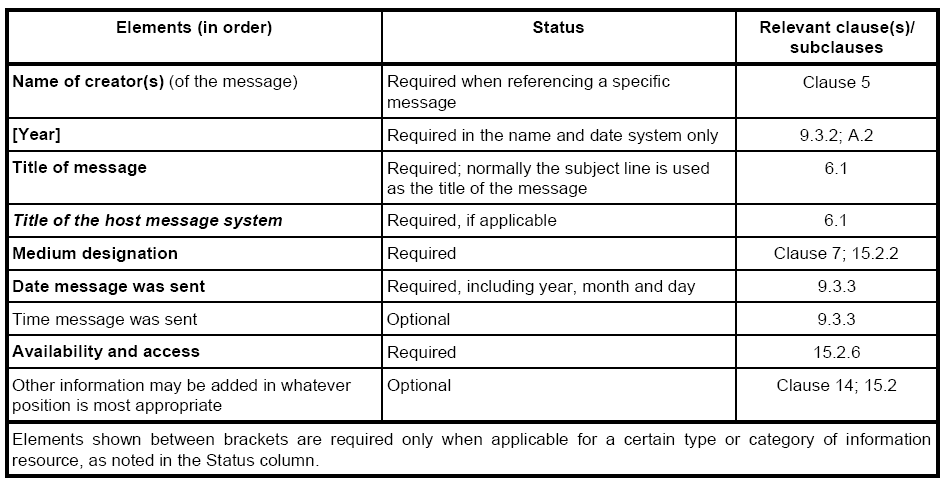
Electronic messages, discussion lists, bulletin boards, etc.

Table B.5 shows the elements, in order, to be included in references to e-mail messages and submissions to electronic discussion lists, bulletin boards, etc.

Table B.5 — References to electronic messages and similar items

[Click to enlarge the image]


Arrangement of alphabetical lists of references

Alphabetical lists of references should be arranged according to the principles in a) to e), based on the first element given in the reference. See also Elements of a reference > Order of elements.

a) A creator's own writings precede any document he/she has cited.

b) A single-creator entry precedes a dual or multi-creator entry beginning with the same name.

c) Multiple entries by a single creator are arranged chronologically, with the earliest information resource first.

d) Multiple creator entries with the same first creator may be arranged chronologically after entries by the first creator alone or with one co-creator, in order to match citations in the information resource which give the first creator's name, “and others” or “et al.” after the date (see also Creator > Multiple creators).

e) Corporate creators (such as institutions) are alphabetized according to the first significant word of the name.


In special circumstances, an alternate order may be used if done so consistently for all references. For instance, in lists of references arranged in classified or subject order, it is often appropriate to place the title first and the creator second. In accession lists of maps, the area may be placed first. In lists of moving-image materials, the title is normally placed first.


noviembre 14, 2013

Methods of citation. Annex A (informative) to ISO 690


Relation between citation in text and reference

Statements in a text should be linked to the bibliographic details of the information resources which support those statements in one of the three ways described in A.2 to A.4.

Name and date system (Harvard system)


Citation in text

The creator's name and the year of publication of the resource cited are given in the text in a name and date system. If the creator's name occurs naturally in the text, the year follows in parentheses, but if not, both name and year are in parentheses. In citations to particular parts of an information resource, the location of that part (e.g. page number) may be given after the year within the parentheses.

If two or more information resources have the same creator and year, they are distinguished by lower-case letters (a, b, c, etc.), following the year within the parentheses.

EXAMPLE
The notion of an invisible college has been explored in the sciences (Crane 1972). Its absence among historians is noted by Stieg (1981b, p. 556). It may be, as Burchard (1965) points out, that they have no assistants, or are reluctant to delegate (Smith 1980; Chapman 1981).


References

The references to the information resources cited in the text are arranged in a list in the alphabetical order of the creators' surnames, with the year of publication and lower-case letter, if any, immediately following the creator's name.

EXAMPLE 1
BURCHARD, J.E., 1965. How humanists use a library. In: C.F.J. OVERHAGE and J.R. HARMAN, eds. Intrex: Report on a planning conference and information transfer experiments. Cambridge, Mass.: MIT Press, 3 Sept. 1965, pp. 41-87.

EXAMPLE 2
CHAPMAN, J., 1981. Report to the British Library Research and Development Department [microfiche]. Birmingham: University School of History. S1/9/281.

EXAMPLE 3
CRANE, D., 1972. Invisible Colleges. Chicago: University of Chicago Press.

EXAMPLE 4
SMITH, C., 1980. Problems of information studies in history. In: S. STONE, ed. Humanities information research, Sheffield: CRUS, pp. 27-30.

EXAMPLE 5
STIEG, M.F., 1981b. The information needs of historians. College and Research Libraries, 42(6), 549-560.


Numeric system

Citation in text

In the citation in text model, numerals in the text, in parentheses, brackets or superscript, refer to information resources in the order in which they are first cited. Subsequent citations of a particular information resource receive the same number as the first. If particular parts of an information resource are cited, page numbers, etc., may be given after the numerals.

EXAMPLE 1 The notion of an invisible college has been explored in the sciences26. Its absence among historians is noted by Stieg13 p. 556. It may be, as Burchard8 points out, that they have no assistants, or are reluctant to delegate27, 28.

or

EXAMPLE 2 The notion of an invisible college has been explored in the sciences (26). Its absence among historians is noted by Stieg (13 p. 556). It may be, as Burchard (8) points out, that they have no assistants, or are reluctant to delegate (27, 28).


References

The references to the information resources should be arranged in their numerical order in a numbered list.

EXAMPLE

8. BURCHARD, J.E. How humanists use a library. In: C.F.J. OVERHAGE and J.R. HARMAN, eds. Intrex: Report on a planning conference and information transfer experiments. Cambridge, Mass.: MIT Press, 3 Sept. 1965, pp. 41-87.

...

13. STIEG, M.F. The information needs of historians. College and Research Libraries, 1981, 42(6), 549-560.

...

26. CRANE, D. Invisible Colleges. Chicago: University of Chicago Press, 1972.

27. SMITH, C. Problems of information studies in history. In: S. STONE, ed. Humanities information research. Sheffield: CRUS, 1980, pp. 27-30.

28. CHAPMAN, J. Report to the British Library Research and Development Department [microfiche]. Birmingham: University School of History, 1981. S1/9/281.


Running notes

Citation in text

For running notes, numerals in the text, in parentheses, brackets or superscript, refer to notes, numbered in the order they occur in the text. The notes may contain references to cited information resources. Multiple citations of one information resource should be given separate note numbers.

EXAMPLE 1
The notion of an invisible college has been explored in the sciences32. Its absence among historians is noted by Stieg33. It may be, as Burchard34 points out, that they have no assistants, or are reluctant to delegate35.

EXAMPLE 2
The notion of an invisible college has been explored in the sciences (32). Its absence among historians is noted by Stieg (33). It may be, as Burchard (34) points out, that they have no assistants, or are reluctant to delegate (35).


One note number should be used for each statement or group of statements supported by a citation; the corresponding note may include more than one source (see note 35 in Example 1 to Methods of citation > Running notes > References).


References

Notes should be presented in numerical order.

A note that refers to an information resource cited in an earlier note should either repeat the full reference or give the number of the earlier note, with any necessary page numbers, etc.

If names are abbreviated, the first note (note 1) should explain all such abbreviations or state where the explanations may be found.

EXAMPLE 1

1. The abbreviations used are:

CRUS = Centre for Research on User Studies

UGC = University Grants Committee

...

8. BURCHARD, J.E. How humanists use a library. In: C.F.J. OVERHAGE and J.R. HARMAN, eds. Intrex: Report on a planning conference and information transfer experiments. Cambridge, Mass.: MIT Press, 3 Sept. 1965, pp. 41-87.

...

15. STIEG, M.F. The information needs of historians. College and Research Libraries, 1981, 42(6), 549-560.

...

32. CRANE, D. Invisible colleges. Chicago: University of Chicago Press, 1972.

33. STIEG, ref. 15, p. 556.

34. BURCHARD, ref. 8.

35. SMITH, C. Problems of information studies in history. In: S. STONE, ed. Humanities information research. Sheffield: CRUS, 1980, pp. 27-30.

36. CHAPMAN, J. Report to the British Library Research and Development Department [microfiche]. Birmingham: University School of History, 1981. S1/9/281.

EXAMPLE 2

1. The abbreviations used are listed on page 357.

...

8. BURCHARD, J.E. ...


noviembre 13, 2013

Specific categories of information resource. ISO 690


General

The specifications in Clauses Elements of a reference to Additional general information apply to these specific categories of information resources in addition to the specifications below. See also Presentation of references (Annex B) > Electronic messages, discussion lists, bulletin boards, etc. for a listing of the elements and Examples of bibliographic references > Examples of bibliographic references to Examples of bibliographic references > Examples of references to musical scores for examples of these and other electronic resources.


Electronic information resources or parts and contributions thereof

General

Some additional or expanded descriptions of the required elements for citing and referencing electronic information resources are given in this clause, which cover the following: electronic monographs, databases and computer programs; electronic serials; electronic discussion lists, blogs and electronic messages.


Type of médium

The type of medium for the electronic information resource should be given in the medium designation (see Medium designation).

EXAMPLE 1
[online].

EXAMPLE 2
[disc].


If desired, the specific type of electronic information resource may also be given.

EXAMPLE 3
[online database].

EXAMPLE 4
[online serial].

EXAMPLE 5
[computer program].

EXAMPLE 6
[electronic mail].

EXAMPLE 7
[digital image].

EXAMPLE 8
[podcast].

EXAMPLE 9
[audiofile].


System requirements

Additional information concerning system requirements beyond that given in the medium designation should be recorded in a note. System requirements may include:

— the type of computer on which the information resource was designed to be read;

the name of the operating system and its version;

— the size of file;

the software requirements;

— the kind of characteristics of any or recommended peripherals.


The wording supplied by the electronic information resource or its documentation should be used. To reduce ambiguity, it is suggested that the words “system requirements” or an equivalent phrase precede this information.

EXAMPLE
System requirements: PC Windows 98, 2000, or XP; 32 MB RAM; 800 600 resolution colour display; Internet Explorer 5.0 or later; Flash 6 or later plug-in; sound card.


Edition

Because electronic information resources are often updated or expanded, they frequently carry a statement of edition. Such words as “edition”, “version”, “level” or “update” may be used. More traditional words such as “revised edition”, “third update” or “training level” may also appear. The number and other designation for the edition should be recorded in the terms given in the source.

EXAMPLE 1
5th edition.

EXAMPLE 2
Version 3.1.

EXAMPLE 3
1.0 Rev A.


Date of citation

The date on which the electronic information resource was actually seen should be given in brackets for information resources which may be subject to changes (e.g. online information resources) or when no other reliable date can be found in the source or the documentation. This date of citation should be preceded by the word “viewed” or an equivalent term.

For electronic monographs or contributions to monographs, the date when the material was accessed should follow:

a) the update/revision date, if one exists (see Edition > Updated versions); or

b) if no update/revision date exists, the numeration/pagination, if either exist; or

c) if neither the update/revision date nor the numeration/pagination exist, the date of the publication (see Elements of a reference > Order of elements and Production > Date).


For serials, this information should follow the numeration and pagination information (see Numeration and pagination).

EXAMPLE 1
[viewed 3 September 2006].

EXAMPLE 2
[viewed 2005-12-29].

EXAMPLE 3
[viewed 17 May 2008, 16:15 EST].


Availability and access

Additional information for identifying and locating the original information resource being cited (see Numeration and pagination > Order of elements) should be provided for online information resources. This information should be identified by the words “Available from” or an equivalent phrase (e.g. “Mode of access”) where appropriate.

The location information for online information resources within a computer network such as the Internet should refer to the copy of the resource which was actually seen, and it should include the network address for its location (e.g. URI, URL), as well as the method of access to the information resource if that method is not apparent in the network address itself. The elements of location information (e.g. address of the host computer, directory name, file name) should be transcribed with the same punctuation, upper-case and lowercase letters as given in the source.

EXAMPLE 1
Available from: http://www.collectionscanada.ca/moodie-traill/index-e.html

EXAMPLE 2
Available from Internet via anonymous FTP from: BORG.LIB.VT.EDU

EXAMPLE 3
Available from: MedlinePlus.


If the location information needs to be broken at the end of a line, the break should be made after a single or double solidus, but made before other punctuation marks.

EXAMPLE 4
Available from: http://www.lac-bac.gc.ca/iso/tc46sc9/
standard/690-2e.htm

EXAMPLE 5
Available from: http://www.gutenberg.org/files/17426/17426-mp3/
17426-mp3-chap10.mp3


If it is deemed helpful for online information resources with long or complex location information, the path to the information resource may also be provided.

EXAMPLE 6
Available from: http://www.culturekiosque.com/art/comment/damien_hirst.html Path: Home; Art; The Death of God: Damien Hirst.


The DOI assigned to the information resource, if applicable, may be supplied in place of its online location information. A DOI or other persistent identifier is preferred to a URL that may change.

EXAMPLE 7 doi: 10.1000/ISBN1-900512-44-0


Other availability information

Information on any other locations or forms of the information resource may also be given. This information should be clearly separated from information which refers to the location of the actual information resource cited, and should be preceded by the words “also available” or an appropriate equivalent phrase.

EXAMPLE
Also available in PDF from: http://www.ukoln.ac.uk/services/elib/papers/other/pinfield-elib/elibreport.pdf


Computer software

When citing computer software, the name(s) of the creator(s) should be given in preference to that of the distributor, even if the latter is more prominently displayed.

Version information should be included if available.

The date of publication should be the date on which the software was released for use. The date of citation should be the date on which the program was accessed in the context of the material being referenced.


Audiovisual material

For audiovisual material, sufficient information should be given about the format of the item to identify the requirements for its playback, e.g. DVD, 16 mm film, MPEG-4.


Cartographic material

General

The projection, prime meridian, orientation and reference systems such as grids and navigational lattices may be given if considered important.


Creator

For cartographic material, the creator's role may be indicated on the map by terms such as “by”,

“cartographer”, “compiled”, “corrected”, “dedicated”, “edited”, “designed”, “drawn”, “copied”, “made”, “engraved”, “revised”, or “updated”.

EXAMPLE 1
Wording on map: Surveyed by Isaac Taylor.
Originator cited: TAYLOR, Isaac.

EXAMPLE 2
Wording on map: Lake District: tourist map. Ordnance Survey.
Originator cited: ORDNANCE SURVEY.


Attributions may be given in the creator element or included in the additional information (see Additional general information). The name of an individual who is known to be the major contributor to the creation of a map should be included, even if it is not prominently displayed.


Production

If both printer and publisher are shown on a map, only the publisher's name should be given.


Map series designation

For cartographic material, the map series designation, if any, should be given in the form in which it appears in the preferred source, preceded, if appropriate, by the term “series”.

EXAMPLE 1
A.D. Maps. A.M. no. 677/2.

EXAMPLE 2
M726.

EXAMPLE 3
Series 1106.


Scale

For cartographic material, the scale should be given, normally as a ratio (calculated if necessary), e.g. “1:50,000”, or, if given otherwise on the map, it may be cited as it appears. “Scale not shown” or “scale indeterminable” may be used if necessary.

EXAMPLE
On the map: “one-inch-to-one-mile”.
Reference: “1:63,360” or “one-inch-to-one-mile”.


If the scale appears in graphic terms, e.g. a scale bar, it may be calculated as a ratio, e.g. “1:63,360” or given in the form on the map, e.g. “scale of miles, 10 [= 60 mm]”.


Size

For maps, charts and plans, the size should be given as the height followed by the width, in millimetres, measured between the neat lines. Other dimensions, such as sheet size, may be given if necessary.

EXAMPLE
1 250 mm 350 mm, sheet 600 mm 800 mm.


For three-dimensional items, height, width and depth should be given.

EXAMPLE
2 Model map: 450 mm 350 mm 20 mm.


For circular maps and globes, the diameter should be given.

EXAMPLE 3
Circular map: 500 mm diameter, on sheet 610 mm 550 mm.

EXAMPLE 4
Globe: 70 mm diameter.


Spectral information/cloud cover

For remotely sensed images, the spectral characteristics of the sensor should be given, together with details of the satellite system, if not given elsewhere in the citation. Information about the amount of cloud cover should be given if appropriate.

EXAMPLE 1
Bands 5, 6, 7, Landsat 2.

EXAMPLE 2
RBV, Landsat 3; 40% cloud cover.

EXAMPLE 3
Infra-red, Meteosat.


Films, videos and broadcasts

Title

Most films, videos and broadcasts are the co-operative output of many individuals, no one of whom has a dominant role as creator. They should be cited with the title as the first element in the reference.

EXAMPLE 1
Macbeth [film]. Directed by Orson WELLES.

EXAMPLE 2
The Archers. BBC Radio.


Creator

For the special purpose of the reference, or to distinguish items with the same title, names of individuals may be cited with their roles as director, producer, actor, etc. The director is preferred (see Creator > Selection). If one individual is clearly responsible for the intellectual content of an item, he or she should be given as creator in the first element.

EXAMPLE
HENDERSON, David. 1985 Reith lectures. BBC Radio, 3 and 4 Nov. – Dec. 1985.


Date

For films, the preferred date is the year of release in the country of production.


Programme within a series

For an individual programme within a series, the number and title of the episode should normally be given, as well as the series title, the transmitting organization and channel, and the full date (i.e. year, month, day and, if necessary, the time of transmission).

EXAMPLE 1
Yes, Prime Minister, Episode 1, The Ministerial Broadcast. BBC 2. 16 Jan. 1986.

EXAMPLE 2
News at Ten. ITV. 27 Jan. 2006. 22:00.


Contributions

Individual items within a programme should be cited as contributions (see Title > Distinction between title of contribution and title of host ítem).

EXAMPLE
THATCHER, Margaret. Interview. In: Six O'Clock News. BBC 1, 29 Jan. 1986, 18:23.


Graphic works

Creator

Several individuals may be concerned in the production of illustrative material. If their names are recorded on the item, they should be included with an indication of their roles, e.g. pinxit (painter), lithographer, sculpsit (sculptor).

EXAMPLE 1
DANIELL, William, fecit. Benj. West, R.A. [lithograph, b&w]. George DANCE, delineavit. London: 1809.

EXAMPLE 2
Flora dispensing her favours on the earth [engraving]. R.A. COSWAY, pinxit, and T. WOOLNOTH, sculpsit.


Location

If in a reference to a graphic work its known location in a library or repository is essential to its identification, location (see Location) should be treated as an essential element.

EXAMPLE
GOSSE, Sylvia (1881–1968). The Garden, Rowlandson House [etching and aquatint, 1912]. At: London: British Museum, Department of Prints and Drawings. Register number 1915-27-41.


Part of another information resource

If a graphic work has been removed or reproduced from a known book or other item, it should be cited as part of that information resource.

EXAMPLE 1
SPY [pseud. of (Sir) Leslie WARD]. Convocation, caricature of the Very Revd Edward Bickersteth, Dean of Lichfield. From: JEHU, Junior [pseud. of Thomas Gibson BOWLES]. In: Vanity Fair Album. London: 1884, vol. 16, Men of the Day, no. 321.

EXAMPLE 2
DÜRER, Albrecht. A hare [watercolour, 1502]. In: E. SCHILLING, Albrecht Dürer Drawings and Watercolours. London: Zwemmer, 1949, frontispiece.


Music

Creator

In references to written or recorded music, the composer should normally be shown as the creator, even if a librettist is given equal prominence.

EXAMPLE
PACINI, Giovanni. II Corsaro. Libretto by Giacomo FERRETTI after Lord Byron.


Size

For music, a score that is musically identical with a full score, but reduced in size, may be described as a miniature score or pocket score if it does not exceed 200 mm in height, or as a study score if it excedes 200 mm in height.


Patents

The order of elements in a reference to a patent should be, with the exception of the date, the same as for a reference to a contribution within a serial (see Presentation of references (Annex B) > Serials > Reference to an entire serial or entire issue of a serial). The name of the proprietor or applicant creator (see Creator > Selection) should precede the title of the patent resource (contribution). The country name or code (see Creator > Organizations or groups > Organizations or groups) and the official designation of the series within which the patent resource is numbered (host resource) should follow.

The patent serial number should suffice as numeration.

If it is not already clear in the reference, the fact that an item is a patent should be stated.

Other information such as the name of the inventor, any classification symbols and the date of application preceded by “Appl:” may be given as additional information between the title and the official designation.

EXAMPLE 1
PHILIP MORRIS INC. Optical perforating apparatus and system. European patent application 0021165 A1. 1981-01-07.

EXAMPLE 2
WINGET LTD. Detachable bulldozer attachment for dumper vehicles. Inventor: Reginald John ENGLAND. 8 March 1967. Appl: 10 June 1963. Int. CI: E02F 3/76. GB CI: E1F 12. GB Patent Specification 1060631.

EXAMPLE 3
CARL ZEISS JENA, VEB. Anordnung zur lichtelektrischen Erfassung der Mitte eines Lichtfeldes. Switzerland, Patentschrift 608626. 1979-01-15.


Reports in series, standards and similar publications

Many reports and similar publications issued in series by research bodies and similar organizations are commonly identified by the series title and number. In references to such publications, the series title and number are essential elements, which may be abbreviated in a generally recognized form, e.g. FIPS PUBS for Federal Information Process Standards Publications.

EXAMPLE 1
INTERNET ENGINEERING TASK FORCE. RFC 3979: Intellectual property rights in IETF technology [online]. Edited by S. Bradner. March 2005 [viewed 18 June 2006]. Available from: http://www.ietf.org/rfc/rfc3979.txt

EXAMPLE 2
NATIONAL INFORMATION STANDARDS ORGANIZATION. ANSI/NISO Z39.53-2001, Codes for the representation of languages for information interchange. Bethesda, Maryland: NISO Press, 2001. National Information Standards series. ISSN 1041-5653. Available from: http://www.niso.org/standards/z39-53-2001/.

EXAMPLE 3
ALTERNATE ENERGY ASSOCIATES. Electric-Car Range Extension Through Hybrid Modification. Final Report. Springfield, VA: NTIS, Jun 1982. DOE/R4/10448-T1. Order No.: DE84000396.


noviembre 12, 2013

Additional general information. ISO 690


General

Additional categories of information that may be included in some references are given in Additional general information > General > Classification to Additional general information > General > Other information. When such information is included in a reference, it should comply with the guidelines recommended below.


Classification

If classification symbols recorded in the information resource are included, the classification scheme should be indicated.

EXAMPLE 1
UDC 001.811:025.171.

EXAMPLE 2
DDC 709.24.

EXAMPLE 3
Int. CI. E02F 3/76. GB CI. E1F 12. (Used with patents.)


Size

If the size of a printed information resource is included in a reference, it may, if appropriate, be given as:

a) the height only, in millimetres,

EXAMPLE 1
210 mm.


b) the height followed by the width, or,

EXAMPLE 2
210 mm x 150 mm.


c) if appropriate, the A-size designation (see ISO 216) followed, when necessary, by “landscape”.

EXAMPLE 3
A5 landscape.


Price and availability

Information about price and availability may be given, as quoted by the publisher.


Languages

The original language(s) used in the text or translations may be mentioned, if appropriate.

EXAMPLE 1
BAARD, H.P. Frans Hals. Translated from the Dutch by George STUYCK.

EXAMPLE 2
ANDRI, Ivo. Il est un pont sur la Drina: chronique de Vichégrad. Translated from Serbo-Croatian into French by Georges LUCIANI.


Registered trade mark

A registered trade mark may be denoted by the symbol “®”.


Other information

Other information relevant to the purposes of the particular reference may be included.


noviembre 08, 2013

Location. ISO 690


If only a limited number of copies of an item are known to exist, “At:” should be given before the place name, qualified if necessary (see Production > Place > General), followed by the name of the repository that holds the cited copy and its call number (or other locator) in the form used by the repository. See also Specific categories of information resource > Electronic information resources or parts and contributions thereof > Availability and access and Specific categories of information resource > Graphic works > Location.

EXAMPLE
GOSSE, Sylvia (1881–1968). The Garden, Rowlandson House [etching and aquatint, 1912]. At: London: British Museum, Department of Prints and Drawings. Register number 1915-27-41.


noviembre 07, 2013

Identifiers. ISO 690


If an item has an international standard number (e.g. ISBN, ISAN, ISMN, ISRC) or other international identifier, e.g. Digital Object Identifier [DOI®1)], that uniquely identifies the resource, it shall be included in the reference (see also Title > Titles of serials > Key title and Specific categories of information resource > Electronic information resources or parts and contributions thereof > Availability and Access).

EXAMPLE 1
Geological Magazine. ISSN 0016-7568.

EXAMPLE 2
MANN, Thomas. Mario the magician & other stories. Translated from the German by H. T. Lowe-Porter. London: Vintage Classics, 2000. ISBN 0-7493-8662-2.

EXAMPLE 3
ROBINSON, R. Quiet and Poised: “Silent” Genes Accumulate Transcription Machinery. PLoS Biol. 2010, 8(1), e1000269. eISSN-1545-7885. ISSN-1544-9173. Available from: doi:10.1371/journal.pbio.1000269


1) DOI® is a registered trademark of the International DOI Foundation. This information is given for the convenience of users of this International Standard and does not constitute an endorsement by ISO of the product named.


noviembre 06, 2013

Series title and number. ISO 690


If a publication also carries the title of a series of which it forms a numbered or unnumbered component, the series title and the numeration of the publication within that series may be included in the reference. The series title and number should be recorded as they appear on the publication.

EXAMPLE 1
Oceanographic report series, 99-12.

EXAMPLE 2
Studies in aboriginal rights.

EXAMPLE 3
Handbook of motivation and cognition. The interpersonal context, vol. 3.


noviembre 05, 2013

Numeration and pagination. ISO 690


General

The components of an item should be cited in the terms used in that information resource, their order following the principle that the larger precedes the smaller.

EXAMPLE
Data Protection Act 1984. Schedule 1, c 35, Part 1, clause 7.


Part cited

The reference should identify the part of the item that is cited. For a contribution, the number and designation of the smallest separately identified component should be given. See also Methods of citation > Name and date system (Harvard system) to Methods of citation > Running notes.

EXAMPLE 1
vol. 6, no. 3, pp. 25-45.

EXAMPLE 2
vol. 2, plate XXV.

EXAMPLE 3
fiche 4, frame B5.


In music, if reference to a particular bar is required, the most exact form of reference available should be used.

Bar numbers should not be cited unless they are printed on the score.

If the whole of an item is being cited, its extent may optionally be stated in brackets.

EXAMPLE 4
http://www.eursurveillance.org/ViewArticl.aspx [7pp].


Omission of terms

The term “volume” and terms for smaller components of a serial publication may be omitted and the numbers distinguished typographically, with the volume number in bold type and the part number, if required, in parentheses.

EXAMPLE
6(3), 25-45.


noviembre 01, 2013

Production. ISO 690


Place

General

The place of production should be given as it appears most prominently in the preferred source. If the place is known but not mentioned in the preferred source, it may be supplied in brackets.

For larger, well-known places, the place name alone may be given. For smaller places, a qualifier should be added (e.g. county, department, state, province, country) to the place name.

EXAMPLE 1
London.

EXAMPLE 2
London (Ontario).


Names of countries, counties, etc., may be coded in accordance with ISO 3166-1 and ISO 3166-2.


Multiple places

If two or more place names appear equally prominently in association with one publisher, distributor, producer, etc., only the first place name should be given.


Publisher or alternative

General

The organization or person shown most prominently in the preferred source (see Elements of a reference > Sources of data) as responsible for the production of the cited item should be given as publisher.

EXAMPLE
DIALOG INFORMATION SERVICES. Enhancements to the DIALOG Search System: DIALOG version 2 (user manual update). Palo Alto [California]: DIALOG, 1985 Nov. Technical Memo 5.


The organizations or people responsible are likely to be variously described in different kinds of items. The order of preference should be:

a) publisher or production company;

b) distributor or issuing body;

c) printer or manufacturer;

d) sponsoring body.


Publishers' names may be abbreviated by omitting details not essential for identification.


Multiple publishers

If the names of two or more organizations appear equally prominently in the same role, only the first should be given.


Sponsor, distributor, etc.

If appropriate, the name of a sponsoring body or distributor may be given as well as the publisher's.

EXAMPLE 1
Chichester: Phillimore, for the Society of Genealogists.

EXAMPLE 2
Paramount Pictures 1928. London: distributed in the UK by Universal International Pictures (UK).

EXAMPLE 3
Distributed by Arista Records Inc., 1776 Broadway, New York, NY 10019. Originally released on Savoy MG 9003, 1947.


Date

General

The date of publication, manufacture, distribution, execution, transmission, etc., should be cited. Normally the year is sufficient, but for some kinds of items (e.g. online information resources, newspapers, patents, television images and remotely-sensed images), the month and day, and sometimes the time, may be necessary.

For audiovisual materials cited from a transmission rather than from the physical item, the date and time of transmission and the transmitting organization should be given, if no other unique identifier of the particular edition is available.

If the copyright date is cited (see Multiple dates), it should be preceded by the symbol “©” or “cop”. Alternatively, the English word “copyright” or its equivalent in other languages may be used.


Year

The year should usually be given as it appears in the preferred source, however, years written as words in the information resource should be given as numerals in the reference.

If the information resource bears a date from a calendar system other than the Christian Era (CE), the applicable system should be given with the date and its equivalent in the CE calendar system should be supplied in brackets.

EXAMPLE 1
Jewish calendar 5685 [1925].


If the year given on the information resource is known to be incorrect, the correct year should also be supplied in brackets.

EXAMPLE 2
1959 [i.e. 1995].


Month, day, time

If a more precise date is required, it may be shown:

a) in numerals, in the order year, month, day and, if necessary, hour, minute, second (see ISO 8601);

EXAMPLE 1
1984-02-10, 13:43:11.


b) with the month spelled out, either in full or abbreviated, and with day, month, year and time given in the order used in the preferred sources (see Elements of a reference > Sources of data);

EXAMPLE 2
10 Feb. 1984.


c) if appropriate, as shown in the preferred source, e.g. the name of a season or a university term.


No date

If the year of publication is not given but can be ascertained, it should be supplied. If an exact date is not known, an approximate date, followed by a question mark or preceded by “ca.”, should be supplied. If no such approximation is possible, that should be stated.

EXAMPLE 1
[ca. 1750].

EXAMPLE 2
[16th century].

EXAMPLE 3
[no date].


Multiple dates

In a reference to a reprint, facsimile or other copy, the date of publication of that edition or, for a copy, the date of the original, should be given, along with the date of reprinting or copying.

EXAMPLE
1796 copied 1810.


If the date on the preferred source, e.g. a copyright date, is different from that of the publication date, both may be given.

If the copyright date is cited (see 9.3.5), it should be preceded by the symbol “©” or “cop”. Alternatively, the English word “copyright” or its equivalent in other languages may be used.


Year

The year should usually be given as it appears in the preferred source, however, years written as words in the information resource should be given as numerals in the reference.

If the information resource bears a date from a calendar system other than the Christian Era (CE), the applicable system should be given with the date and its equivalent in the CE calendar system should be supplied in brackets.

EXAMPLE 1
Jewish calendar 5685 [1925].


If the year given on the information resource is known to be incorrect, the correct year should also be supplied in brackets.

EXAMPLE 2
1959 [i.e. 1995].


Month, day, time

If a more precise date is required, it may be shown:

a) in numerals, in the order year, month, day and, if necessary, hour, minute, second (see ISO 8601);

EXAMPLE 1
1984-02-10, 13:43:11.


b) with the month spelled out, either in full or abbreviated, and with day, month, year and time given in the order used in the preferred sources (see Elements of a reference > Sources of data);

EXAMPLE 2
10 Feb. 1984.


c) if appropriate, as shown in the preferred source, e.g. the name of a season or a university term.


No date

If the year of publication is not given but can be ascertained, it should be supplied. If an exact date is not known, an approximate date, followed by a question mark or preceded by “ca.”, should be supplied. If no such approximation is possible, that should be stated.

EXAMPLE 1
[ca. 1750].

EXAMPLE 2
[16th century].

EXAMPLE 3
[no date].


Multiple dates

In a reference to a reprint, facsimile or other copy, the date of publication of that edition or, for a copy, the date of the original, should be given, along with the date of reprinting or copying.

EXAMPLE
1796 copied 1810.


If the date on the preferred source, e.g. a copyright date, is different from that of the publication date, both may be given.


octubre 31, 2013

Edition. ISO 690


Different editions

The edition should be specified in the terms, including symbols, used in the preferred source.

EXAMPLE 1
3rd ed., revised.

EXAMPLE 2
New enlarged edition.


If different editions of a journal are published in different countries, e.g. Canada and the USA, the country of publication should be given after the title.


Updated versions

For items that are likely to be updated, altered or destroyed, in whole or in part, the reference should make clear which version is being cited by giving the number of the release, update or equivalent, and the year, with, if necessary, the month, day and time (see 9.3.3), when that version was created or the information obtained.

EXAMPLE 1
PARALOG AB. 3RIP® [program]. Version 4.0. Stockholm: Paralog, 1981.

EXAMPLE 2
Financial Times Commodity Reports. Prestel®, page 248310, 1983-06-09 [consulted 1999-04-12, 13:57].

EXAMPLE 3
Mac OS X Update 10.4.7 Intel [software]. 27 June 2006.


For the use of the “®” symbol, see 14.6.

For clarity, both the original date of publication and the date of the update may be included.

EXAMPLE 4
International DOI Foundation. DOI Handbook [online]. ©2006. Updated 19 September 2007 [viewed 20 May 2008]. Available from: http://www.doi.org/hb.html


octubre 30, 2013

Medium designation. ISO 690


If necessary, information about the nature of the information resource and/or the form in which it is made available should be given in brackets. See also Specific categories of information resource > Electronic information resources or parts and contributions thereof > Type of medium on the medium designation for electronic information resources.

EXAMPLES

[Braille]

[cine film (35 mm)]

[computer tape reel]

[CD]

[DVD]

[Blu-ray disc]

[film strip (35 mm)]

[globe]

[map]

[microfiche (48x)]

[microfilm reel (16 mm negative)]

[photograph]

[score]

[slide (2 in.)]

[sound disc (45 rpm)]

[videocassette (VHS PAL)]

[wall chart]


octubre 29, 2013

Title. ISO 690


Form of title

Preferred form

The wording and spelling of the title should be given in the form in which it appears in the preferred source (see Elements of a reference > Sources of data).


Alternative forms

If alternative forms of title are given in the preferred source, the most prominent should be used. If several forms are given equal prominence, the form used should be one of the following, listed in order of preference:

a) a title in the language and script mainly used in the cited information resource;

b) the title given prominence by the order of titles or the layout;

c) a title in the language of the main target audience;

d) for cartographic material [in preference to a) or b)]:

1) an overprinted title,

2) a title in the title panel,

3) a title within the grid or other border which encloses the detail of a map,

4) a title elsewhere;

e) for graphic works:

1) a title forming part of the original design,

2) a handwritten title on the information resource, or custodian’s description,

3) a popular or traditional title, e.g. Mona Lisa;

f) other forms of title.

EXAMPLE
Eric, or Little by little: a tale of Roslyn School.


Other title

If the cited item is widely known by, or was originally issued under, a title different from that of the preferred source, the alternative may also be given, in brackets if necessary.

EXAMPLE 1
CENTRAL ADVISORY COUNCIL FOR EDUCATION (ENGLAND). Children and their primary schools [Plowden Report].

EXAMPLE 2
Cutter’s Way [Cutter and Bone] [film].

EXAMPLE 3
GREAT BRITAIN. House of Commons. Official Report. Parliamentary debates [Hansard].


Long title

A title that is inconveniently long may be shortened by the omission of some words, but initial words, other than the definite or indefinite article, should not be omitted, nor should the sense be altered. The omittedwords, with the exception of omitted articles, should be replaced by three dots (for abbreviation of periodical titles, see Titles of serials > Abbreviation).

EXAMPLE

On source: Map of the countries lying between Turkey and Birmah, comprising Asia Minor, Persia, India, Egypt and Arabia and including the Black, Caspian and Red Seas.

Reference: Map of the countries lying between Turkey and Birmah...


Subtitles

Subtitles should be included if they furnish essential information about the content of an information resource (see also Form of title > Ambiguous or incorrect title), otherwise they may be omitted.

EXAMPLE 1
Etheldreda's Isle: a pictorial map of the Isle of Ely to commemorate the 1300th anniversary of the founding of Ely's conventual church.

EXAMPLE 2
Eric, or Little by little: a tale of Roslyn School.


Ambiguous or incorrect title

Elucidation of a title that is ambiguous or fails to indicate clearly the content of the information resource may be supplied in brackets after the title. If a title contains an obscure abbreviation, the full form, if known, may be supplied.

EXAMPLE 1
Statistical digest of the war. [1939–1945].

EXAMPLE 2
Two trio sonatas for two violins and basso continuo. [Op.5 no. 4, 5.].


For cartographic material, the special subject and area covered should be supplied if not given in the title. The supplied name of a geographical area should be the name in use at the date of production, rather than a modern equivalent.

EXAMPLE 3
National topographic map series. 1:100,000. [Queensland index map].

EXAMPLE 4
Gull’s eye view [of Hugh Town, St Mary's, Scilly Isles].


No title

If there is no clear title in the cited item, a popular or traditional title may be given, if one exists. Otherwise, a title should be supplied in brackets, giving the following information:

a) the special subject matter;

b) the nature of the item (e.g. pamphlet, map, plan, drawing, index, engraving, photograph) and if applicable, the name of the object depicted (e.g. the person, building, location, etc.);

c) for a single cartographic item (e.g. atlas, single-sheet map), the area covered.

EXAMPLE 1
[Wildlife sanctuaries of Trinidad].

EXAMPLE 2
Untitled [Judo fighters] [photograph]. In: Starkey, Hannah. Moments in the modern world: photographic works by Hannah Starkey 1997–2000. Irish Museum of Modern Art, 2000. ISBN 1-873654-90-1.


For a map series as a whole, the scale and series designation should also be supplied, if they are necessary to distinguish the series from others of the same area.

EXAMPLE 3
[Western Australia forestry series. 1:63,360].

EXAMPLE 4
[Hong Kong. 1:1,000. Series HP1C].


For graphic works, the subject matter and print process should be supplied.

EXAMPLE 5
PELHAM, Henry, del. [Quin Abbey, Co. Clare. General view] [engraving].


Translation of title

The original title of a translated information resource, or a translation of the title, may be supplied immediately after the original title.

EXAMPLE 1
The Artamonovs [Delo Artamonvykh].

EXAMPLE 2
Delo Artamonovykh [The Artamonovs].


Titles of serials

Qualifiers for titles

If the title of a serial issued by a society or similar organization is insufficient in itself to identify the publication, the organization's name should be added.

EXAMPLE 1
Bulletin trimestriel. Institut archéologique du Luxembourg.


Serials with the same title should be distinguished from each other by the addition of the place of publication.

EXAMPLE 2
Natura (Amsterdam).
Natura (Bucharest).


Key title

The key title (see ISO 3297), if any, may be given in place of the form which appears in the preferred source (see Elements of a reference > Sources of data). The International Standard Serial Number (ISSN) (see Identifiers) shall be included.

EXAMPLE 1
Geological Magazine. ISSN 0016-7568.

EXAMPLE 2
Journal of Technological Education [online]. ISSN 1045-1064.


Earlier or later titles

Earlier or later titles of a serial may be given, with the years when the title was in use.

EXAMPLE
British Journal of Physical Education. 1970– .

Journal of Physical Education. 1945–1954.

Physical Education. 1955–1959.


Abbreviation

Titles of periodicals for which no key title is available may be abbreviated in accordance with ISO 4. If there is any risk of ambiguity, the title should be given in full.


Distinction between title of contribution and title of host ítem

If the cited item is a contribution, its title shall be typographically distinguished from that of the host item. For monographic publications, the use of the word “In:” should precede the title of the host item. The use of the “In:” connector is not needed for citations that are contributions from journals and is optional for other types ofserial publications.

EXAMPLE 1
Belle de Jour. In: Magill’s Survey of cinema [online]. Pasadena [CA]: Salem Press, 1985– [viewed 1994-08-04]. Accession number 0050053. Available from: Dialog Information Services, Palo Alto [CA].

EXAMPLE 2
BRY, I., and L. AFFLERBACH. In search of an organizing principle for behavioural science literature. Community Mental Health Journal. 1968, 4(1), pp. 75-84. ISSN 0010-3853.

EXAMPLE 3
CLARK, Carol. On the threshold of a brave new world. In: Blueprint of the body [online]. CNN.com, 2000 [viewed 24 August 2000; 10:25 EST]. In-depth specials. Available from: http://www.cnn.com/SPECIALS/2000/genome/story/overview/

EXAMPLE 4
McCONNELL, W. H. Constitutional history. In: The Canadian encyclopaedia [CD-ROM]. Macintosh version 1.1. Toronto: McClelland & Stewart, ©1993. ISBN 0-7710-1932-7.

EXAMPLE 5
MICHAEL, D. The effect of local deformations on the elastic interaction of cross walls coupled by beams. In: COULL, E.A. and B. STAFFORD-SMITH. Tall buildings. Oxford: Pergamon Press, 1967.


In other languages, a connector other than “In” may be preferred, for example the use of “Julkaisussa” in Finnish.

EXAMPLE 6
SUHONEN, Pertti. Suomalaiset arvot ja politiikka. Julkaisussa: Aikamerkki. 1989, 62(1), 2-23.


Conferences

If regular conferences are held with the same title, it may be necessary to add the date and place of the conference for clarity.


octubre 25, 2013

Creator. ISO 690


Selection

The persons (see Personal names) or organizations (see Elements of a reference > Organizations or groups) shown most prominently in the preferred source (see Elements of a reference > Sources of data) as responsible for the content of the cited item, in its published form, should be given as creator. The creator’s role varies from one type of information resource to another. If there is no obvious creator, one should be selected from the following roles, listed in order of preference:

a) author, composer, librettist, mapping agency, surveyor, cartographer, copyist, system designer of software, patentee, patent applicant, artist, photographer, draughtsman, graphic designer;

b) conductor, performer of music, drama, etc., director of films, inventor;

c) compiler, editor, reviser;

d) translator, engraver, photographer of another creator’s work, copyist, arranger, software programmer;

e) publisher, online information provider, production company;

f) distributor, online host.


For cited information resources containing a number of contributors, a role with which a single creator is associated should be preferred to any role with which several creators are associated (see also Title first).

EXAMPLE 1
AYMARD, Maurice, ed. Dutch capitalism and world capitalism. In: Studies in Modern Capitalism. New York: Cambridge University Press, 1982, pp. 78-96.

EXAMPLE 2
BRITTEN, Benjamin. Eight folk song arrangements for high voice and harp. Osian ELLIS (Ed). London: Faber Music, 1980.

EXAMPLE 3
KING’S SINGERS. Christmas with the King’s Singers: six arrangements for mixed voices. London: Chappell Music, 1981.


Personal names

General

Names of creators should normally be given in the form in which they appear in the preferred source (but see Variant forms), transliterated if necessary (see Elements of a reference > Transliteration).

Forenames or other secondary elements should be given after the surname, if at the beginning of the reference.

EXAMPLE 1
BACH, C.P.E.

EXAMPLE 2
DÜRER, Albrecht.

EXAMPLE 3
FOWLER, H.W.

EXAMPLE 4
GORDON, Dexter.

EXAMPLE 5
RAMON Y CAJAL, Santiago.


Treatment of secondary elements should follow the practice of the nation to which the creator belongs as closely as possible.

EXAMPLE 6
FALLA, Manuel de. [Spanish].

EXAMPLE 7
LA FONTAINE, Jean de. [French].

EXAMPLE 8
DE LA MARE, Walter. [English].

EXAMPLE 9
KLEIST, Heinrich von. [German].


Variant forms

If a creator’s name appears in different forms in different information resources cited in one work (e.g. Tchaikovsky, Chaikovski), the form used in the cited information resource should be retained. Only one form of the name, in brackets if necessary, should appear as the first element.


Additions

Additions to names indicating rank, office or status (academic, professional, etc.) may be retained or supplied to distinguish creators with the same names.

EXAMPLE 1
CLARK, William, ARIBA.

EXAMPLE 2
CLARK, William, MD, MRCP.

EXAMPLE 3
BALFOUR, Robert [Col.].

EXAMPLE 4
BALFOUR, Robert [Rev.].


Organizations or groups

Form of name

If the creator is an organization or group of people, the form of name used in the reference should be that which appears for the name in the bibliographic database being used for making the reference, usually a reference to a name in a national authority file, transliterated if necessary (see Elements of a reference > Transliteration).

EXAMPLE 1
ACADEMIA SCIENTIARUM FENNICA.

EXAMPLE 2
ACADÉMIE FRANÇAISE.

EXAMPLE 3
AKADEMIYA NAUK SSSR.

EXAMPLE 4
INSTITUT GÉOGRAPHIQUE NATIONAL.

EXAMPLE 5
MAGYAR SZABVANYUGYI.

EXAMPLE 6
ROYAL SOCIETY.


If the name appears as a group of initials, the full form, if known, may be added in brackets, unless the body is usually identified by the initials only, e.g. UNESCO, NATO.


Ambiguous names

To distinguish between different bodies with the same name, the appropriate place name should be added.

EXAMPLE
TRINITY COLLEGE [Cambridge].
TRINITY COLLEGE [Dublin].


Subordinate body

If the name of an organization implies subordination to a parent body of which it is an organ or administrative division, or if its full significance depends upon the inclusion of the name of the parent body, the latter should be given first in the reference.

EXAMPLE 1
IMPERIAL CHEMICAL INDUSTRIES. Paints Division.

EXAMPLE 2
MINISTRY OF PETROLEUM AND MINERAL RESOURCES. Air Survey Department.


A subordinate body should appear under its own name if it has specific functions of its own and the full significance of its name is independent of that of the parent body.

EXAMPLE 3
ACADÉMIE FRANÇAISE. [not INSTITUT DE FRANCE. Académie française].

EXAMPLE 4
WORLD HEALTH ORGANIZATION. [not UNITED NATIONS. World Health Organization].


Parent body

If the parent body is a state, a federation of states or a provincial, local or municipal authority, a name in general use should be given in preference to a full or correct official name. Foreign names may be given in the language of the information resource or in the language of the main target audience.

EXAMPLE 1
FRANCE. [for République française].

EXAMPLE 2
HULL. [for Kingston-upon-Hull].

EXAMPLE 3
WESTMINSTER. [for City of Westminster].


For patents (see Specific categories of information resource > Patents), the country of origin or originating office may be abbreviated according to the ISO 3166 country code or the World Intellectual Property Organization (WIPO) ST3 code.

EXAMPLE 4
GB. [for United Kingdom].


Multiple creators

Two or three creators

If there are two or three creators of equal status, their names should be given in the reference. The name that is given first should be in a form that is suitable to the alphabetical arrangement of a list, i.e. usually in inverted order (family name recorded first). The name(s) of the second and subsequent creators may be recorded in direct order, if desired. A consistent system of recording such names shall be used throughout the list of references.

EXAMPLE 1
MURET, Pierre and Philippe SAGNAC.

EXAMPLE 2
Bundesanstalt für Bodenforschung and UNESCO.

EXAMPLE 3
QU H.Q., C. POLYCHRONAKOS, and TYPE I DIABETES GENETICS CONSORTIUM.


More than three creators

For works with four or more creators, all names should be given if possible. If any names are omitted, the name of the first creator shall be given followed by “and others” or “et al.”.

EXAMPLE FITTING, Hans and others.


Title first

For certain kinds of information resources (e.g. encyclopaedias) or if an item is the co-operative output of many individuals, none of whom has a dominant role as creator (e.g. films), the title should be used instead of a creator. For references to information resources with several creators, it may be appropriate to give the title or series title first (but see Selection). (See also Anonymous Works and Specific categories of information resource > Films, videos and broadcasts > Title)

EXAMPLE 1
Encyclopaedia Britannica.

EXAMPLE 2
The last command [silent film]. Directed by Josef VON STERNBERG.

EXAMPLE 3
60 years of cool. Blue Note Records OBSBN01, 1999.


Conferences

If no person or organization can be identified as the creator (see Selection) of the proceedings of a single conference, the name of the conference should be treated as the first element.

EXAMPLE
International Conference on Scientific information. Washington DC, 1958.


The numbered proceedings of a series of conferences should be treated as a serial.


Subsidiary creator

To facilitate identification of a particular information resource, or because of relevance to the purpose of the citation, the name of any editor, translator or other person who has collaborated in the production of that resource may be added after the title with an indication of the role, so placed in the reference that the relation between that role and the whole or part of the information resource is clear.

EXAMPLE 1
BAARD, H.P. Frans Hals. Translated from the Dutch by George STUYCK.

EXAMPLE 2
BACH, C.P.E. Sonate G-moll für Violine und obligates Cembalo. Herausgegeben von Anne Marlene GURGEL.

EXAMPLE 3
FOWLER, H.W. A dictionary of modern English usage. 2nd ed. Revised by Sir Ernest GOWERS.

EXAMPLE 4
Macbeth [film]. Directed by Orson WELLES.


Originators of multiple editions

If a new edition, abridgement or updated version of an information resource is produced by a new creator, the name of the first creator should be used if it appears as a creator in the preferred source.

EXAMPLE 1
PARKER, T.J., and W.A. HASWELL. A text book of zoology. 6th ed. Vol. 1 revised by Otto LOWENSTEIN; vol. 2 revised by C. FORSTER-COOPER. London: Macmillan, 1940.

EXAMPLE 2
GORDON, Dexter. Settin’ the pace. In: Long Tall Dexter, the Savoy Sessions [sound disc]. New York: Savoy, 1976, SIL 2211, side B, track 5. Distributed by Arista Records Inc., 1776 Broadway, New York, NY 10019. Originally released on Savoy, MG 9003, 1947.


Pseudonyms

If a work has been issued under an assumed name, normally this name only should be given in the reference.

EXAMPLE 1
CARROLL, Lewis.

EXAMPLE 2
MAUROIS, André.


If the creator’s real name is known, it may also be supplied preceded by “pseud. of”.

EXAMPLE 3
BLAKE, Nicholas [pseud. of Cecil Day LEWIS].

EXAMPLE 4
Æ [pseud. of RUSSELL, George William].


Anonymous Works

For anonymous works cited by the name and date system (see Methods of citation > Name and date system (Harvard system)), “Anon” may be used instead of a creator’s name. For anonymous works cited by the numeric system (see Methods of citation > Numeric system) or running notes (see Methods of citation > Running notes), the title may be treated as the first element. If the creator’s name is known, it may be supplied.


octubre 24, 2013

Basic principles for creating references. ISO 690


1. The information included in a reference should be sufficient to clearly identify the material being cited.

2. The creator of the reference should determine the appropriate level of specificity at which the reference is made (e.g. to an entire document or to a specific part of a document) based on the purposes of the citation and the use that was made of the material being cited.

3. The data included in a reference should, whenever possible, be taken from the information resource being cited.

4. The data recorded in the reference should reflect the specific copy or instance of the document that was used. For online documents that are subject to change, such data include the network location of the particular version that was used and the date on which the document was accessed.

5. A uniform style, format and punctuation scheme shall be used for all references in a document, regardless of the particular style guide being used.


Elements of a reference. ISO 690


Sources of data

General

The data used in a reference should, if possible, be taken from the cited information resource itself. An eye-readable source of data should be preferred to any other. Where possible, the text of machine-readable, microform or audiovisual sources should be viewed to verify the elements of the reference. Data that are taken from a source other than the item itself should be recorded in brackets.

Suitable sources of data for the reference, in order of preference, are the following:

a) title page or equivalent, such as title screen, home page, disc label, map face;

b) verso of title page, header, etc.;

c) cover or label permanently associated with the item, including captions on graphic works, microfiche headers, etc.;

d) container;

e) accompanying documentation, e.g. explanatory leaflet or manual.


If any element of data appears in different forms in different places on the item, the form appearing most prominently in the preferred source should be used unless that source is obviously incorrect, e.g. an incorrect label has been attached.

Data supplied from other sources

Any information that does not appear in the cited information resource, but is supplied by the citer, should be enclosed in brackets.


Transliteration

Any element in a non-Roman alphabet may be transliterated or romanized in accordance with the appropriate International Standard.


Abbreviation

Generally accepted bibliographic terms should be abbreviated in accordance with the rules established in ISO 832. Other abbreviations should be avoided, except as provided in Creator > Organizations or groups > Parent body for patents, in Title > Titles of serials > Abbreviation for series titles, for graphic works and in for running notes.


Punctuation and typography

A consistent system of punctuation and typography should be used throughout a list of references. Each element of a reference should be clearly separated from subsequent elements by punctuation or change of typeface.
NOTE In order to emphasize the importance of consistency, a uniform scheme of punctuation is used in the examples in this International Standard. The scheme is purely illustrative and does not form part of the recommendations.


Order of elements

The usual order of elements in a reference is as follows:

a) name(s) of creator(s), if available;

b) title;

c) medium designation, if necessary;

d) edition;

e) production information (place and publisher);

f) date [in the name and date system (see Methods of citation), the year should not normally be repeated in this location unless a fuller date is necessary (e.g. for a serial)];

g) series title, if applicable;

h) numeration within the item;

i) standard identifier(s), if applicable;

j) availability, access or location information;

k) additional general information.

If the name and date system, commonly referred to as the Harvard system (see Annex A), is being applied, the year element is inserted after the creator.

EXAMPLE
CRANE, D., 1972. Invisible Colleges. Chicago: University of Chicago Press.


Presentation of references (Annex B) illustrates the application of this recommendation in particular circumstances related to serials, monographs, contributions and special categories of information resource.


octubre 23, 2013

Terms and definitions. ISO 690


call number

Reference provided to enable the custodian to locate a resource within a repository.


citation

Indication within the text or other form of content of a relevant reference.


computer program

Schedule or plan that specifies actions expressed in a form suitable for execution by a computer. [ISO/TR 9544:1988]


contribution

Item provided by a creator to form part of a host resource from several creators. EXAMPLE An article in a serial.


creator

Entity primarily responsible for making the resource. [ISO 15836:2009]


database

Collection of data objects stored together in electronic form, according to one schema, and made accesible by computer.
NOTE Some databases, or files within a database, can also constitute a monograph or serial publication. In cases where it can readily be determined that a specific electronic resource is a monograph or serial, those terms are preferred over the broader term “database”.


graphic works

Graphics such as photographs (including negatives and transparencies), engravings, prints, drawings, wall charts, etc.


key title

Unique name for a continuing resource, established by the ISSN Network and inseparably linked with its ISSN. [ISO 3297:2007]


landscape

Orientation of a page with the longer edge running horizontally when it is in reading position.


map series

Number of related map sheets designed to form a single group, normally distinguishable by such common characteristics as a collective title, a sheet-numbering system and the same scale.
NOTE Normally a map series is the work of one mapping agency.


map height

Vertical measurement of a map when the map is in reading position.


map series designation

Coded numeric or alphanumeric identification applied to a map sheet, a map series or an atlas by the Publisher.


monograph

Publication in print or non-print form, complete in itself or intended to be completed in a finite number of parts.


neat line

A line separating the body of a map from the map margin


reference

Data describing a resource or part thereof, sufficiently precise and detailed to identify it and to enable it to be located.
NOTE A reference can be: part of a list of information resources; the heading of an abstract or a critical review; a note appended to a text, either at the foot of the page or at the end of a text; or a statement embodied in the text.


serial

Publication in print or non-print form, issued in successive parts, usually having numerical or chronological designations, and intended to be continued indefinitely, whatever the periodicity.
NOTE Serials can include periodicals, journals, newspapers, annuals, etc.


series

Group of monographs, serials or other publications sharing a common title, and possibly numbered.